
Receive Art-Net, sACN and DMX, process them on board, and send them out on 8 DMX lines, over the network, to an LED strip or as audio. Everything is wired with the mouse, in your browser, live.
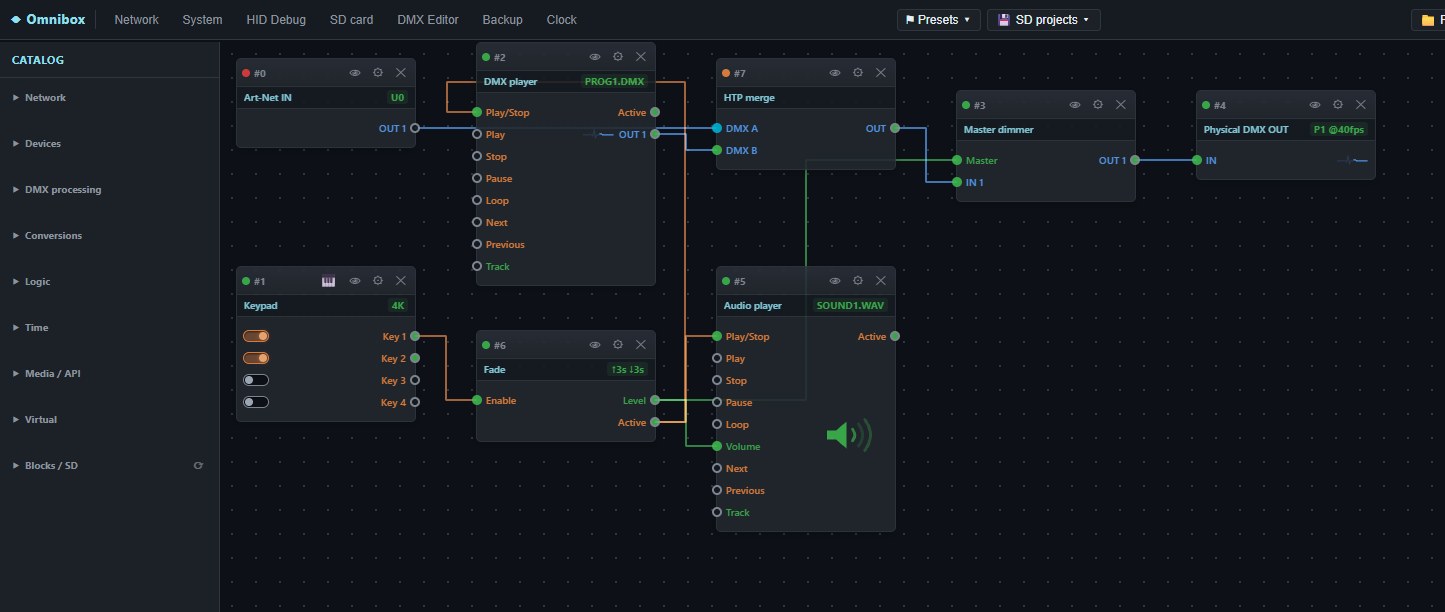
The OmniBox is not set up through menus: you place modules on a grid and connect them. A lighting desk, a DMX console, a key or the clock come in on one side; merge, dimmer, player or threshold work in the middle; fixtures, the network, an LED strip or sound go out on the other.
Open the OmniBox's address in a browser, on a PC, Mac or tablet. Drag a module from the catalogue, draw a wire from an output to an input: the signal flows straight away, with no restart. Port colours show the signal type, indicators show where it is flowing.
No software to install. And without a network, a simple USB cable is enough to take control of the machine.
A single box replaces the network node, the merger, the recorder and the small automation logic usually added around an installation.
One universe per port, refresh rate adjustable from 1 to 44 frames per second, port by port. Each port can also become a DMX input.
Receive and transmit, up to 32 consecutive universes: the protocols of professional lighting desks and software.
HTP and LTP merge, master dimmer, backup source, smoothing, 16-bit conversion, copy and multi-patch, RGB to RGBW.
Record what the desk sends onto the SD card, play it back in a loop or on demand, track by track.
WAV and MP3 files from the SD card, with controllable volume: sound and light start together.
WS2812 and SK6812 output: drive an LED strip directly from the patch.
Push buttons or switches, colours of your choice, solo mode for presets, LEDs controllable from the patch.
Real-time clock, recurring time windows, calendar and timers: the installation runs on its own.
An API input over UDP or TCP receives text or binary messages and turns them into commands.
Powered over the network (PoE) or by USB-C. Configured in the browser, or over USB with no IP address.
The patch saves itself two seconds after every change. Projects and blocks can be exported to a PC or to the SD card.
English, French, German, Spanish and Italian.
Each module does one thing, and does it well. Connecting them is what turns the OmniBox into a network node, merger, dimmer, recorder, trigger or show player.
The Backup module watches the primary source. If frames stop arriving, it switches to the backup source; when the primary comes back and stays stable, it hands control back. Two wires and one module are all it takes.
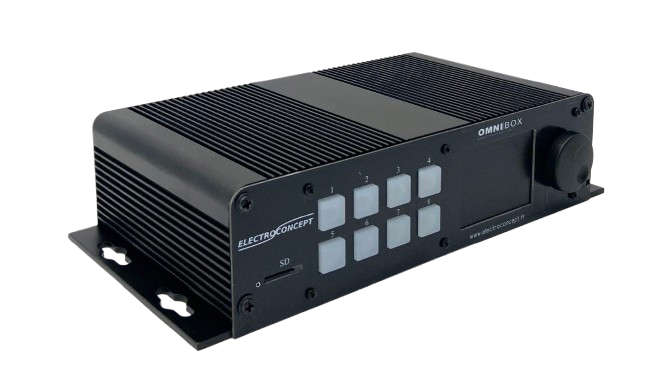
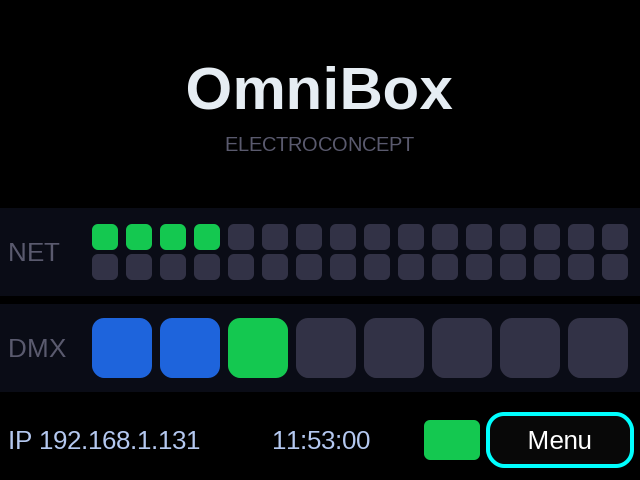
In the browser, the whole patch; on the device, a colour screen and a rotary encoder for the network address, the clock, module status and the SD card.
Art-Net / sACN node to 8 DMX lines, merge with a console, backup source.
A rugged box you reconfigure in a few clicks, on site, from a laptop or a tablet.
Recorded shows, synchronised sound, triggering from a key, the clock or a network message: the installation runs on its own.
The API input over UDP or TCP plugs into a PLC, a supervision system or in-house software.
| DMX outputs | 8 independent DMX512 ports, one universe per port, each port configurable as an input |
|---|---|
| DMX refresh rate | Adjustable from 1 to 44 frames per second, port by port |
| Network protocols | Art-Net and sACN (E1.31), input and output, up to 32 universes |
| Network | Ethernet, static address or DHCP, multicast management (IGMP) |
| Configuration | Web browser, or USB without an IP address |
| Storage | microSD card: DMX sequences and audio files |
| Audio | WAV and MP3 playback from the SD card |
| Addressable LEDs | WS2812 and SK6812 |
| Controls | 8 programmable RGB-backlit keys, colour screen and rotary encoder |
| Clock | Battery-backed real-time clock |
| Memory | Automatic configuration saving |
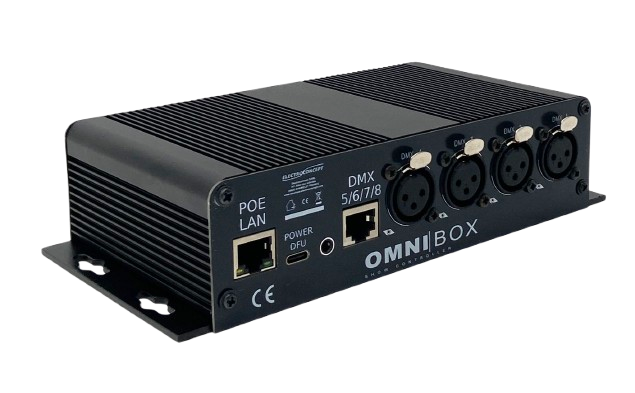
| DMX connectors | 3-pin XLR for universes 1 to 4; RJ45 extension for universes 5 to 8 (shielded cable and plugs) |
| DMX isolation | All 8 ports are opto-isolated: universes 1 to 4 individually, universes 5 to 8 with a common ground |
| Power supply | USB-C, or PoE over the Ethernet cable |
| Dimensions | 220 × 100 × 102 mm |
| Weight | About 350 g |
| Operating temperature | −10 °C to +40 °C |
Latest published update: . See the available updates (page in French) →
Two 3-pin XLR daughter boards for universes 5 to 8: four outputs, or four outputs two of which can be switched to inputs. Available in the shop.
See the daughter boards →Short animated videos with voice-over, from the first wire to a recorded show.
The catalogue, the anatomy of a block, port types, drawing and removing a wire, following the signal.
A tour of the top bar: settings windows, Presets and SD projects, the File, Blocks and Edit menus.
From the network to the fixtures: Art-Net on two universes, two physical DMX outputs.